The internet doesn’t “accidentally” make things go viral anymore—there’s a pattern, a vibe, and yes, a formula. Some videos barely get past your close friends, while others detonate across TikTok, Instagram, YouTube, and X in a matter of hours. If you’ve ever thought, “Why that clip?” this is your breakdown. We’re decoding the five trending elements that keep showing up in the videos everyone is sharing, stitching, and dueting right now.
The First Three Seconds Are Your Entire Career
On today’s feeds, people don’t “watch” your video; they audit it in under a second. That opening frame is doing more work than the rest of your clip combined. Viral creators are treating the first three seconds like a movie trailer: loud hook, clear payoff hint, zero confusion.
Instead of a slow intro, you’re seeing instant drama: someone gasping, a wild visual, a bold caption like “I can’t believe this worked,” or an obvious “before” shot that promises a satisfying “after.” Platforms even reward this: TikTok and YouTube Shorts both push content with strong retention, and retention starts with stopping the scroll. That’s why text-on-screen hooks, tight close-ups, and movement in the first second are everywhere. If your video doesn’t answer “Why should I care right now?” it’s already lost.
Raw > Perfect: The Anti-Polish Era
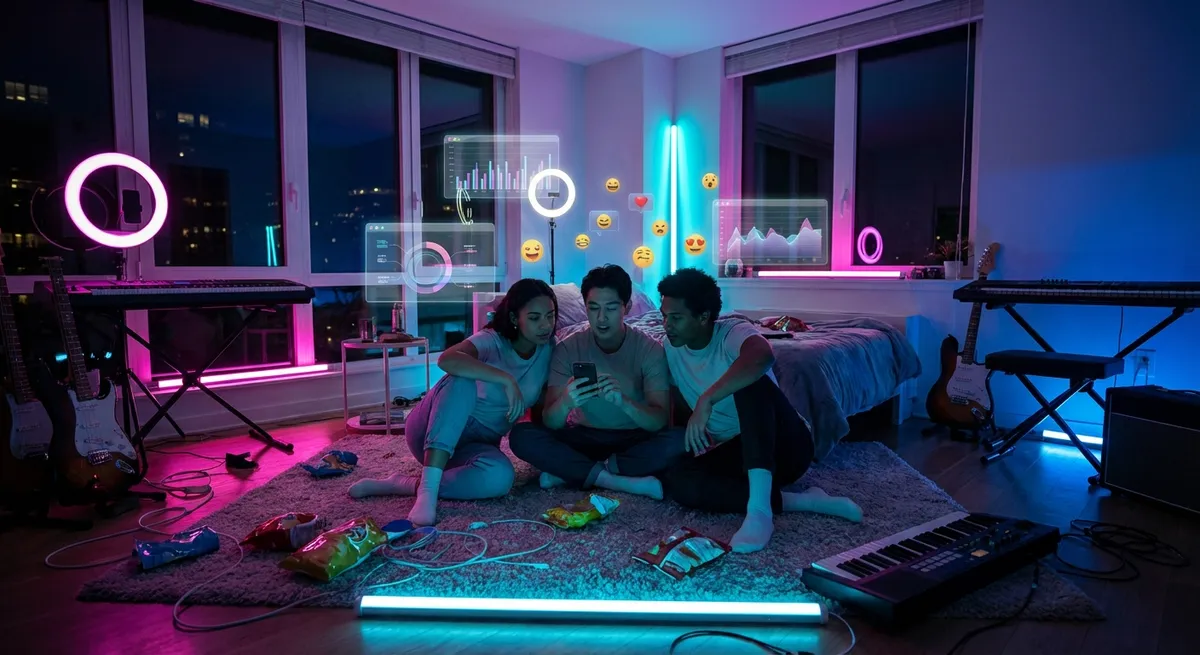
We’re living in the anti-commercial era of viral video. High-budget, studio-looking clips often feel like ads—even when they aren’t. What’s winning instead? Shaky phone clips, chaotic audio, slightly messy rooms, and unfiltered reactions. It feels like a friend sending you something, not a brand broadcasting at you.
This “raw over perfect” trend is showing up in everything from GRWMs to street interviews to behind-the-scenes “mistakes” that end up getting more views than the polished version. Viewers are clocking authenticity in milliseconds—your awkward laugh, your unedited facial expression, your “wait, keep recording” moment. It’s not that editing is dead; it’s that over-sanitized content screams “try-hard.” Viral hits in 2024–2025 feel like they weren’t supposed to be posted… which makes people trust and share them more.
Build-In Participation: Don’t Just Post, Start a Chain Reaction
The videos going the farthest right now are built like open invitations, not finished products. Instead of “Watch what I did,” it’s “Now you try.” Viral clips are turning viewers into participants—duets, stitches, remixes, green screens, lip-syncs, filters, sound trends, and “tell me without telling me” prompts.
Think about how many hits are basically interactive templates: “Use this sound with your pet,” “Show your glow-up to this audio,” “Point to the word that fits you,” “POV: you use this filter and react.” People aren’t just sharing; they’re recreating, reacting, and replying. The smartest creators design their content for remixability: clear structure, easy repeatable action, and a hook that makes people say, “I need to add my version.” The more people can put themselves inside your idea, the faster it spreads.
Micro-Stories: Tiny Plots With Massive Payoff
Long storytelling isn’t gone—it’s just compressed. Viral videos are basically mini-movies now, with a beginning, middle, and punchline all squeezed into 10–45 seconds. The clips that grab attention usually do one thing extremely well: they build curiosity and then deliver a satisfying payoff.
You’ll see story captions like “Wait for the end,” “This did NOT go how I expected,” or “Part 1: the disaster.” Viewers are subconsciously tracking your “plot”: setup (what’s going on?), tension (what might happen?), and resolution (what actually happens?). It might be a cooking fail, a surprise reunion, a prank reveal, or a transformation—but there’s always a clear arc. If your video is just a vibe with no payoff, people scroll. If there’s a tiny mystery—“What is that noise?” “Will this work?” “Who’s behind that door?”—people watch, comment, and send it to friends with “YOU NEED TO SEE THIS.”
Emotion Whiplash: From Laughing to “I’m Not Okay” in One Clip
The most shared videos right now don’t just make you feel something—they flip your emotions fast. That hard left turn from funny to heartwarming, from scary to wholesome, from cringe to “I’m crying” is engagement gold. The brain loves contrast, and feeds love anything that keeps you locked in.
Think of pet videos that start chaotic and end tender, prank setups that turn into surprise proposals, or “I thought this was a fail” clips that actually reveal a big win. This quick emotional pivot makes people react out loud, which leads to comments like “I did NOT expect that,” “Why am I tearing up?” and “I went from laughing to sobbing in 10 seconds.” That level of emotional swing doesn’t just earn views—it earns rewatches and DMs. And the algorithm notices when people can’t resist hitting replay or sending it to five friends.
Conclusion
Viral videos might look random, but the ones flooding your feed right now keep repeating the same playbook: brutal first-second hooks, unpolished authenticity, built-in participation, tiny bingeable story arcs, and emotional whiplash that makes people feel everything at once. You don’t need a studio, a script, or a marketing team—you need to understand how people actually scroll, react, and share.
If you’re posting in 2025, you’re not just “uploading content.” You’re dropping potential chain reactions into an attention war. Treat every clip like a micro-story, an invitation, and a moment your viewers can see themselves in. That’s the real viral clip chemistry—and once you see it, you can’t unsee it.
Sources
- TikTok Newsroom – How the TikTok algorithm recommends videos - Explains how TikTok’s recommendation system prioritizes watch time, engagement, and relevance
- YouTube – Official Creator Academy: Making Shorts - Breaks down best practices for YouTube Shorts, including hooks and retention
- Pew Research Center – Social Media and Video Sharing Use - Data on how people use social media and consume short-form video
- Harvard Business Review – What Makes Online Content Go Viral - Research-backed analysis of emotional triggers and shareable content
- NYTimes – The TikTok-ification of Everything - Discusses the rise of short-form video and how it’s reshaping online behavior
Key Takeaway
The most important thing to remember from this article is that this information can change how you think about Viral Videos.