Social media just had a major glow-up—again. The apps didn’t really change, but the way people are using them definitely did. Forget generic selfies and “new post” captions. The new scroll culture is about storytelling, chaos, and hyper-personal vibes that feel like you’re on FaceTime with the creator.
If you want your posts to actually get saved, shared, and stitched instead of ghosted, you need to understand what’s really hitting right now. These five trending moves are exactly what social users are sharing, copying, and low-key obsessing over.
1. “Unpolished On Purpose” Is the New Aesthetic Flex
The internet is over perfection. The most shareable posts right now feel like someone dropped their camera in the group chat and hit “send to all.”
Creators are leaning hard into:
- Unedited front-camera clips with chaotic lighting
- Shaky “walking and talking” videos that feel like venting to a friend
- Screenshots of notes-app rants, unfiltered thoughts, and messy drafts
This vibe works because it feels real in a feed packed with polished content. When people feel like they’re seeing something raw instead of produced, they’re more likely to comment, share, or duet it. Even big brands are testing this with “behind-the-scenes” clips, using regular employees, unperfected audio, and outtakes that used to stay on the cutting room floor.
The sneaky part? A lot of this “unpolished” content is actually very intentional: planned hooks, quick cuts, and smart pacing wrapped in a casual, off-the-cuff delivery. The end result: content that reads as “I just whipped this up” while being engineered to keep you watching.
2. Hyper-Niche Content Is Going Mega-Wide
The fastest way to go viral right now is surprisingly not trying to “appeal to everyone.” It’s going full niche and letting the algorithm do the rest.
You’ve seen it:
- “POV: you’re the oldest daughter in an immigrant family”
- “If you also overthink what to text back, this is for you”
- “Day in the life of a barista who hates mornings but loves espresso foam art”
These ultra-specific posts work because they hit two audiences at once:
People who feel deeply seen (“I thought it was just me”)
People who find the niche so oddly specific that it’s entertaining anyway
And the shareability is off the charts. People tag friends like, “This is literally you,” or save it because it nails a feeling they’ve never put into words. The internet is proving that the more specific you get, the more people you actually reach.
3. Micro-Stories Are Beating Traditional “Content”
Attention spans are cooked, but story hunger is at an all-time high. The winning format right now? Micro-stories: tiny, bingeable narratives packed into 15–60 seconds.
They show up as:
- “You won’t believe what my roommate did today (part 1)”
- Ultra-short “storytime” clips with text on screen and fast jumps
- Mini arcs in Instagram carousels where each slide advances the story
Instead of “Here’s my outfit,” it’s: “I wore this to a date where I thought he ghosted me but then this happened.” Same content, but now it’s a plot.
Micro-stories trigger:
- Curiosity: People watch to the end to see what happened
- Comments: Everyone has an opinion and wants to weigh in
- Shares: Users send it in DMs like, “You need to see this right now”
Creators who nail this format treat every post like the middle of a movie: no long setup, just immediate drama, context, or emotion that hooks you in the first second.
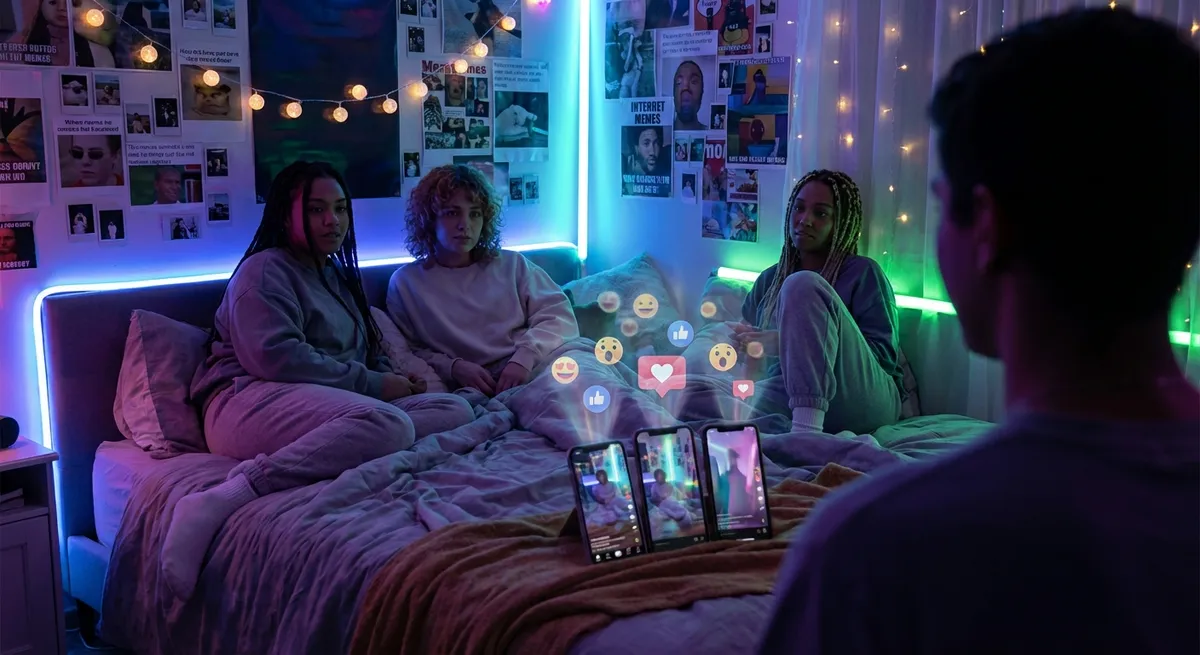
4. “Group Chat Energy” Captions Are Taking Over
The caption is no longer an afterthought—it’s part of the show. The trend now is writing like you’re texting your best friend at 1 a.m., not submitting a polished quote to a magazine.
Think:
- All lowercase, chaotic punctuation: “soooo that happened. anyway. we move”
- Inside-joke references and specific slang your audience already uses
- Captions that add a twist: “The real story is in slide 4, don’t judge me”
- Make people feel like part of an inner circle
- Invite replies that feel like conversation, not “audience engagement”
- Turn the comments into an extension of the joke or story
These captions work because they:
Bonus trend: questions that don’t feel like forced engagement. Instead of “What do you think?” it’s “Okay but am I the villain here or…?” or “Tell me your version of this immediately.” That framing gets people typing paragraphs, not emojis.
5. Remix Culture: The New Currency of Clout
The internet used to reward the originator of a trend. Now, it rewards whoever remixes it the smartest. You don’t always have to create from scratch—you can ride the wave by flipping what already exists.
Remix culture looks like:
- Duets and stitches that react, roast, or add context to a viral clip
- Using trending audio but changing the story or subverting the expectation
- Screenshotting a viral tweet or post and adding your own spin in the caption or video
It’s not about copying; it’s about re-framing. “Here’s why this is actually wrong,” “Here’s the side you’re not seeing,” or “Same audio, completely different mood.” That’s the game.
This works because:
- Algorithms love content built on already-popular sounds or formats
- Viewers enjoy seeing multiple angles on the same trend
- Your version can blow up even if you didn’t start the trend
Right now, the internet is less “Who did it first?” and more “Who did it best?” The remixers are winning.
Conclusion
The social media flex in 2026 isn’t just going viral—it’s feeling worth going viral. Unpolished-on-purpose clips, hyper-niche stories, chaotic captions, and clever remixes are turning everyday posts into share magnets.
If you want your content to move beyond likes and actually live in DMs, group chats, and stitches:
- Drop the fake polish
- Get specific, not generic
- Tell tiny, addictive stories
- Talk like a real person, not a brand deck
- Remix the culture instead of chasing it
The scroll never sleeps—but if you play it right, it won’t forget you either.
Sources
- [Pew Research Center – Social Media Fact Sheet](https://www.pewresearch.org/internet/fact-sheet/social-media/) - Data on how people are using major social platforms and demographic trends
- [Harvard Business Review – How TikTok Is Rewriting the Rules of Social Media](https://hbr.org/2022/07/how-tiktok-is-rewriting-the-world-of-social-media) - Explains why short-form, story-driven and remixable content is dominating feeds
- [MIT Technology Review – The Algorithms That Make TikTok So Addictive](https://www.technologyreview.com/2021/03/11/1020600/the-algorithms-that-make-tiktok-tick/) - Breaks down how recommendation systems push niche and highly engaging content
- [Meta – Instagram Trend Report](https://about.fb.com/news/2022/12/instagram-trend-report-2023/) - Insights into youth culture, authenticity, and emerging content formats on Instagram
- [NYTimes – How the Internet Became a Group Chat](https://www.nytimes.com/2023/01/06/style/group-chat-social-media.html) - Explores the shift toward intimate, chat-like communication online
Key Takeaway
The most important thing to remember from this article is that this information can change how you think about Social Media.