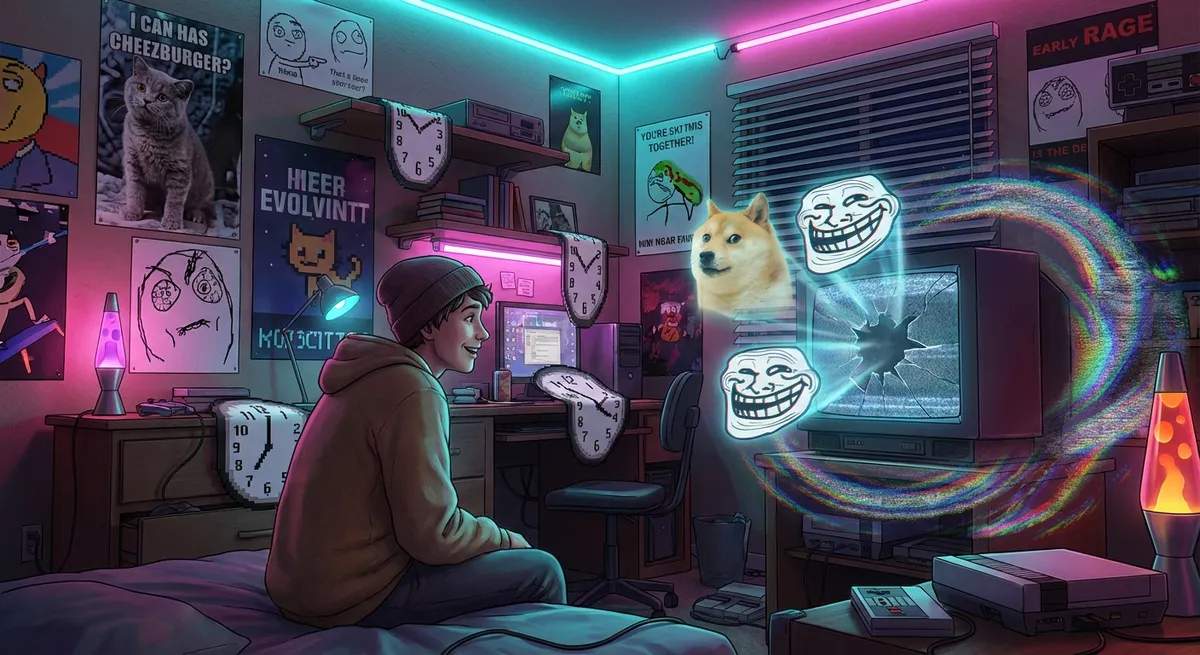
If you’ve been online longer than five minutes, you’ve seen it happen: a meme you thought was dead in 2016 suddenly shows up on your FYP, remixed, re-captioned, and somehow funnier than ever. Welcome to meme time travel—the chaotic loop where old jokes refuse to stay in the past and keep getting reborn for a new generation of scroll addicts.
This isn’t just random internet chaos. There are real patterns behind why certain memes come back, how they get upgraded, and what makes them share-bait all over again. Let’s crack open the meme multiverse (without repeating it, literally) and look at the 5 biggest comeback trends your feed is obsessed with right now.
Nostalgia Remix: When Throwback Memes Get a 2020s Upgrade
The internet has the memory of a goldfish… until nostalgia kicks in.
We’re living in a full-blown throwback era online. Old formats like “Loss” comics, Rage Faces, “Bad Luck Brian,” and even Impact-font image macros are getting a glow-up. Creators are taking these “cringe classics,” layering them with hyper-specific 2020s problems (student loans, dating apps, AI everything), and suddenly they feel painfully current again.
Why it hits so hard: nostalgia + relatability. The people who grew up with those early memes are now adults with bills, burnout, and way too many tabs open. When a dusty old meme format shows up saying exactly what you’re feeling in 2026, it slaps different. You’re not just laughing at the joke — you’re low-key time traveling back to your first smartphone, your first YouTube binge, your first “I’m staying up all night on Tumblr” era.
Sharing power: high. A revived meme format connects generations of internet users. Older fans hit share because it’s iconic, younger users share because it’s “ironically retro,” and the meme basically markets itself across timelines.
Template Hopping: One Meme Format, A Million Timelines
Some memes don’t just trend — they migrate.
You’ve seen this in real-time: one meme format explodes on Twitter/X, jumps to TikTok with a sound attached, then morphs into Instagram carousels and YouTube compilations. It’s the same core idea, but each platform gives it a different vibe: text-heavy on X, POV storytelling on TikTok, aesthetic edits on IG, meme essays on YouTube.
This “template hopping” is why certain memes feel literally everywhere. The format becomes a blank canvas: “X, but make it about my fandom,” “X, but it’s my job,” “X, but it’s my toxic habit.” The more customizable the template, the longer it lives and the further it spreads.
The secret sauce: low-effort, high-relatability. People don’t want to spend 2 hours making a meme, but they will absolutely slap one line of text onto an existing format if it lets them tell a micro-story about their personality, their community, or their oddly specific struggle.
Bottom line: if a meme format is easy to personalize and works across video, text, and images, it’s not just a trend — it’s a traveling circus.
Hyper-Specific Chaos: Ultra-Niche Memes Going Weirdly Viral
We’ve entered the era of “there’s a meme for that” — and “that” can be insanely specific.
Memes used to be broad: “relatable student life,” “Mondays suck,” “me vs. food.” Now? People are making memes about being the oldest sibling in a diaspora family with strict parents, memes about oddly specific subreddits, memes about one tiny feature in a single mobile game. And somehow, those posts hit 1M+ views.
What changed: algorithmic feeds reward strong emotional reactions, not broad appeal. A meme that hits 10 out of 10 people mildly is weaker than a meme that hits 1 out of 10 people perfectly. When something is hyper-specific to your life, you don’t just like it — you share it, bookmark it, tag 4 friends, and duet it.
This is why you keep seeing memes that feel like personal attacks in your own language, subculture, fandom, or profession. Your feed has been trained on you. The more niche it gets, the more it feels like the meme is staring directly into your soul.
Share value: off the charts. Hyper-specific memes practically come with a built-in caption: “This is literally us,” “tagging the group chat,” “why is this so accurate.” That’s algorithm fuel.
Reaction Economy: How Memes Became the New Body Language
Memes aren’t just content anymore — they’re communication.
Instead of typing “I’m dead,” you send the meme of someone collapsing dramatically. Instead of explaining you’re stressed, you send the burning dumpster GIF, a “this is fine” dog, or that one side-eye kid. Whole conversations are just trading clips, formats, and screenshots with zero extra text needed.
This “reaction economy” turns memes into emotional shortcuts. They carry tone, attitude, and context that plain text doesn’t. You don’t have to say “I’m annoyed, but in a funny way, and I still love you” — you just drop the right meme and your friend gets it instantly.
What’s wild is how global this has become. A reaction meme can cross languages and cultures faster than a paragraph ever could. One screenshot of a celebrity face, one animal doing something chaotic, one cartoon with the perfect expression — and the whole internet adopts it as emotional currency.
Result: every time a new TV show, live event, or music video drops, the race is on to screenshot, crop, and turn it into the next go-to reaction. The first ones to do it right? Instant clout, follows, and reposts.
Meme Speedruns: From Viral Birth to Instant Backlash
The internet used to let memes breathe. Now? They live, die, and get rebooted in days.
Here’s the new cycle:
- A format appears, usually from a random clip, TV show, live stream, or TikTok.
- Early adopters post creative spins. It’s chaotic, it’s fresh, it’s fun.
- Brands, boomers, and official accounts pile on. The format starts feeling overused.
- Irony phase hits: people meme the meme, complaining about the meme, killing and reviving it in the same week.
- It “dies”… until someone resurrects it months later with an actually good twist.
We’re basically speedrunning meme history. The same pattern that used to take years now happens in a weekend. But here’s the twist: because everything is moving so fast, nothing ever fully disappears. Meme formats get archived in our collective internet brain, waiting for a creator to revive them with a new angle.
If it feels like you’re constantly in a loop of “weren’t we done with this?” — you are. But that loop is the culture now. The meme isn’t just the joke; it’s the whole life cycle, including its death and comeback tour.
Conclusion
Memes aren’t just background noise to your scrolling — they’re the language, the nostalgia machine, the reaction toolbox, and the chaos engine of the entire internet.
Old formats will keep returning with new context. Templates will keep jumping platforms. Hyper-specific jokes will keep targeting your oddly personal life experiences. Reaction memes will keep replacing actual words. And every “dead” meme is secretly waiting backstage for its comeback arc.
The real power move? Notice the patterns, join the remix, and maybe be the person who pulls a forgotten meme out of retirement and makes it go viral all over again.
Because online, time is fake — but memes? Memes are forever.
Sources
- Know Your Meme - Comprehensive database documenting the history, origins, and evolution of memes and viral content
- Pew Research Center – Teens, Social Media and Technology - Data on how younger audiences are using and engaging with online platforms where memes spread
- MIT Technology Review – How memes got weaponized - Explores the cultural and social power of memes in the modern internet ecosystem
- The Atlantic – The Internet Is a Tragedy Machine - Analysis of how online culture, including memes, recycles events and emotions at high speed
- BBC – The secret rules of the internet - Background on how digital communities and platforms shape what becomes visible, shareable, and viral
Key Takeaway
The most important thing to remember from this article is that this information can change how you think about Memes.