Memes aren’t just jokes anymore—they’re how the internet thinks, reacts, and drags everything in real time. Blink for five seconds and there’s a new sound, screenshot, or cursed image dominating your feed. If you’ve ever said “Wait, where did THIS come from?” while scrolling, this is your crash course in what’s actually driving meme culture right now.
Let’s plug into the five biggest meme currents shaping your timeline—and probably your group chat—for the next viral wave.
1. Screenshot Culture: Turning Every App Chat Into Meme Material
Your camera roll is basically a museum of chaos—and half of it is screenshots. That’s not an accident. Screenshots have quietly become one of the internet’s favorite meme formats: texts taken out of context, wild customer service emails, cursed group chat moments, absurd review comments, or unhinged app notifications.
Why it hits so hard:
- Screenshots feel “real,” even when they’re staged
- They turn private moments into instantly shareable content
- One image can tell an entire story in a single glance
- They’re perfect for low-effort, high-relatability posts
Platforms like X (Twitter), TikTok, and Instagram Reels are flooded with posts built from screenshots of Reddit threads, Discord convos, and Facebook comments. People are literally porting content from one platform to another just for meme value.
What this means for you: if it made you do a double-take, it’s probably meme fuel. The line between “personal” and “postable” is thinner than ever—and internet culture is basically being written in iPhone screenshot format.
2. Audio First, Visual Second: How Sounds Are Becoming the Meme
We used to meme with images and text. Now, we meme with sound. TikTok and Instagram Reels turned audio into the new template: one 5-second clip of someone saying something dramatic, unhinged, or oddly specific—and suddenly every creator is acting it out.
You’ve seen it everywhere:
- One line from an interview becomes “the” sound for breakup skits
- A movie quote becomes the go-to for “me vs. me” videos
- A random background noise becomes the soundtrack for “when you realize…” memes
Creators don’t even need to explain the joke anymore; the audio is the explanation. You just pair it with the right visual and your followers instantly get the vibe.
Why this matters: meme culture is shifting from “What’s the punchline?” to “What sound are we using?” If you recognize the audio before you recognize the creator, you’re living in peak sound-driven meme era.
Pro tip for staying ahead: pay attention to the audios you hear more than three times in a day. That’s not your algorithm glitching—that’s the birth of a trend.
3. Template Remixing: Old Formats, New Chaos
Some meme formats never die—they just get remixed until they feel brand new again. Reaction pics, “me vs. the guy she told me not to worry about,” “starter packs,” “expectation vs. reality”—these are all templates the internet has basically on permanent retainer.
What’s changing now is the speed and creativity of the remix:
- People mash multiple formats into one chaos meme
- Old templates resurface with new, hyper-specific contexts
- One screenshot becomes the skeleton for 10,000 variations
Instead of inventing something from scratch, meme-makers grab an existing blueprint and just inject a new situation—jobs, fandoms, niche hobbies, hyper-local drama, astrology signs, you name it.
That’s why you’ll see the same structure a hundred different ways, but somehow it never gets old—because each remix is like an inside joke for a different corner of the internet.
Net effect: memes aren’t just single jokes anymore. They’re living formats that evolve with every new cultural moment, event, or scandal. The template is the canvas; the remix is the art.
4. Hyper-Specific Relatability: “This Is So Me It Hurts”
The internet has moved past generic “When you’re tired” memes. Now it’s all about ultra-targeted, extremely specific experiences that make a tiny percentage of people feel insanely seen—and everyone else still laughs because of how bizarrely niche it is.
Think:
- “When you’re the oldest sibling in a family that communicates only via shared memes”
- “POV: you’re the friend who always checks the menu before the restaurant”
- “This is for the people who say ‘I’m on my way’ while still in the towel”
This hyper-specific style works because:
- It feels like the meme is calling you out by name
- It creates micro-communities in the comments (“WHY IS THIS SO ME???”)
- It rewards people for having weirdly particular habits or anxieties
- It’s more personal than broad, generic humor
The new flex online isn’t just being relatable—it’s being so weirdly accurate that people feel exposed. The more niche the meme, the bigger the “OK WHO FOLLOWED ME” energy.
If you’ve ever saved a meme and thought, “I can’t even post this publicly, this is too specific,” that’s exactly the point.
5. Real-Time Reaction Memes: The Internet’s Live Commentary Track
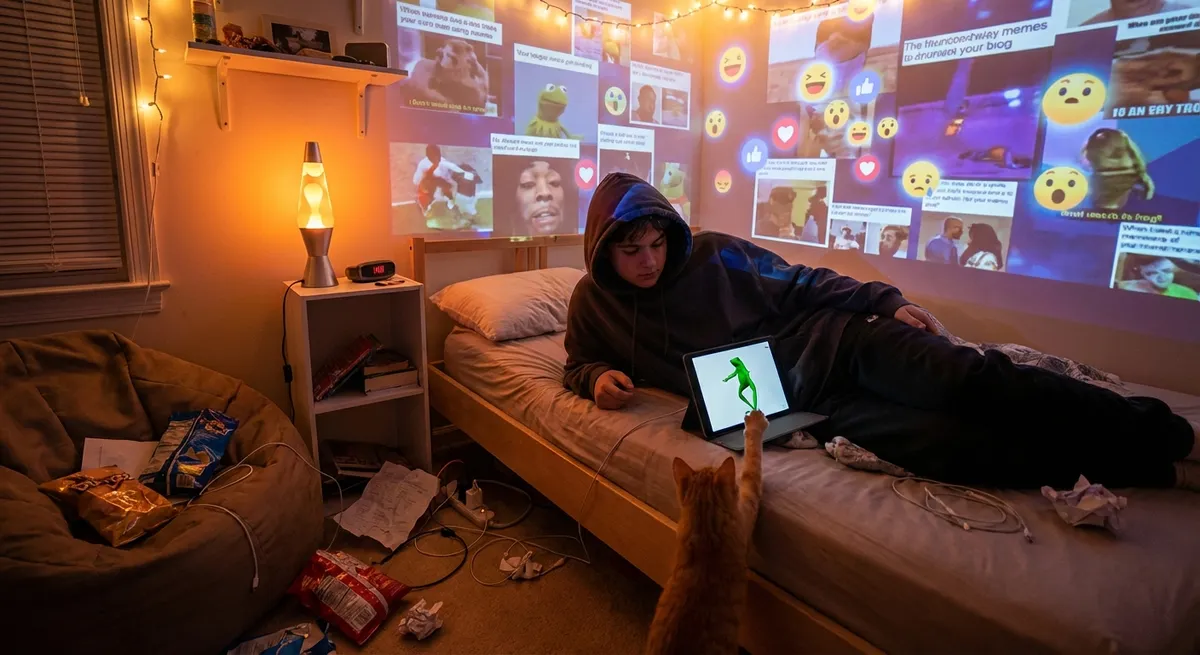
News breaks, a celebrity does something wild, a brand posts something cringe—and within minutes your feed is flooded with reaction memes. The internet has basically become a live group chat for planet Earth, and memes are how we process everything at once.
Here’s what’s driving the wave:
- People react faster with memes than with full-text takes
- One perfect reaction image or GIF can summarize a whole opinion
- Memes let users roast, praise, or question an event without getting too serious
- Algorithms boost highly engaged reaction content, so it spreads extra fast
Large moments—award shows, sports finals, tech launches, scandals—now come with a built-in parallel event: the meme storm. Sometimes the memes are bigger than the event itself.
What’s wild is how quickly trends flip:
- Minute 1–10: confusion memes (“What is happening?”)
- Minute 11–30: chaos memes (screenshots, edits, wild takes)
- Hour 1+: think-pieces and commentary, still powered by meme screenshots
Memes have become the real-time emotional subtitles for everything we collectively witness. If you’re not watching your feed while an event unfolds, you’re missing at least half the story.
Conclusion
Memes aren’t just background noise on your feed—they’re the language, soundtrack, and inside jokes of the entire internet. From screenshot sagas to viral audios, from resurrected templates to “this is SO me” callouts, and live reaction storms that crash timelines, meme culture is moving faster—and getting smarter—than ever.
If you want to stay plugged in, don’t just scroll past the jokes. Pay attention to how they’re built: the format, the audio, the specificity, and the timing. That’s where the real magic (and chaos) is happening.
Now go check your camera roll. Odds are, your next meme is already in there—waiting to blow up someone’s group chat.
Sources
- [Pew Research Center – Teens, Social Media and Technology 2022](https://www.pewresearch.org/internet/2022/11/16/teens-social-media-and-technology-2022/) - Data on how younger users interact with platforms where meme culture thrives
- [MIT – How Memes Spread: A Study of Information Diffusion](https://news.mit.edu/2018/how-memes-spread-through-population-1119) - Research exploring how meme-like information moves through networks
- [The New York Times – How TikTok Is Rewriting the World](https://www.nytimes.com/2019/03/10/style/what-is-tik-tok.html) - Explains how short-form video and audio trends are reshaping online culture
- [BBC Future – Why we can’t resist sharing memes](https://www.bbc.com/future/article/20161026-why-we-cant-resist-sharing-memes) - Breaks down the psychology behind why people share memes
- [Harvard Business Review – When Memes Become Marketing](https://hbr.org/2020/07/when-memes-become-marketing) - Looks at how brands tap into meme formats and real-time reactions
Key Takeaway
The most important thing to remember from this article is that this information can change how you think about Memes.