The wildest part of viral videos right now isn’t the filters, the memes, or the edits—it’s the habits behind the camera. The tiny choices creators make in how they film, talk, move, and post are turning regular clips into “I’ve watched this 12 times” moments. If your videos feel like they’re getting scrolled past in 0.2 seconds, it’s not about making them louder—it’s about making them stickier.
Let’s break down the new viral video habits that are quietly running the internet right now—so you can start using them before your feed catches up.
Micro-Stories: Turning 10 Seconds Into a Whole Plot
The era of “random clip, no context” is fading. What’s hitting now is micro-storytelling—tiny, ultra-condensed narratives packed into super short videos.
Creators are slipping full story arcs into 7–20 seconds: a setup, a twist, a payoff. Think: “I tried this for 30 days…” with a 1-second setup and a fast rewind of results, or “Watch what happens when…” followed by an instant surprise. Your viewer doesn’t have to decode anything; they get the story in one glance.
This works because our brains are wired to follow stories, even ultra-mini ones. A clear “before vs after,” “expectation vs reality,” or “problem vs solution” is more shareable than a clip that just looks cool. People share micro-stories with captions like “THIS IS SO ME” or “this is literally my life,” because they see themselves in the structure, not just the visuals.
To plug into this habit, start asking before you film: “What’s the story here in one sentence?” Then build your clip so the viewer can feel that story without reading a long description. The cleaner the narrative, the easier the share.
Unpolished On Purpose: The Anti-Perfect Aesthetic
The glow of hyper-edited perfection is dimming. Viral videos are leaning hard into “I just grabbed my phone and filmed this… but actually I knew exactly what I was doing.”
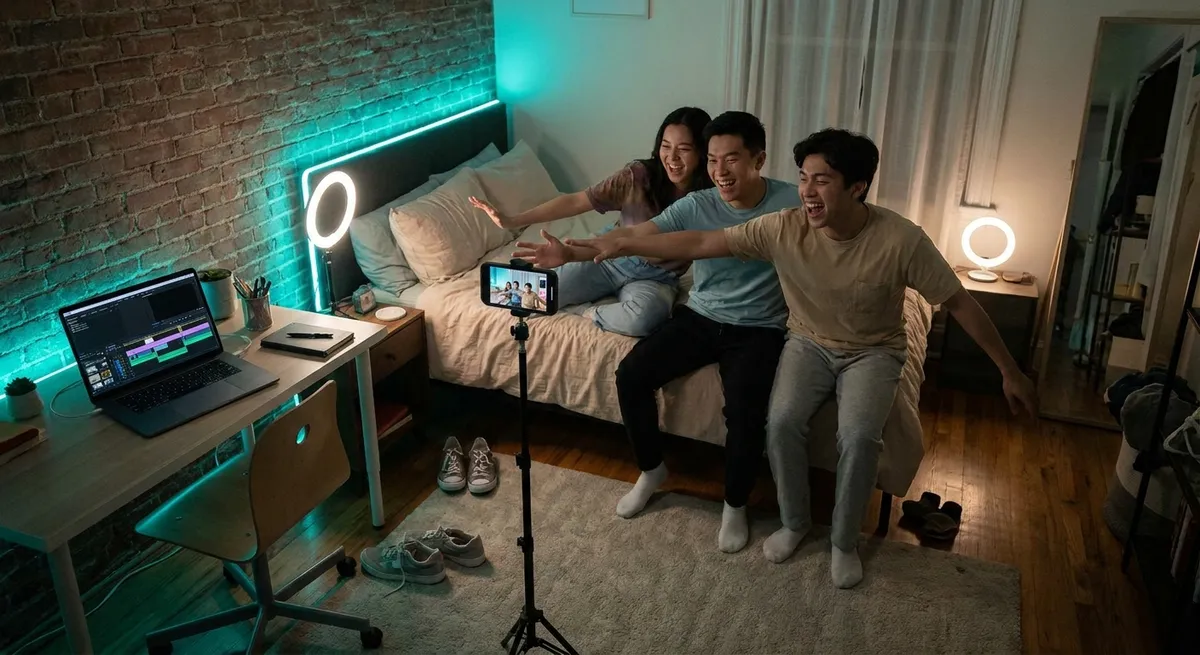
You’re seeing shaky hand-held footage, half-finished makeup, messy rooms in the background, unfiltered lighting, and raw reactions left in. That “I didn’t plan this” vibe tells viewers: “This is real. This is me. This could be you.” But behind that casual feel is smart framing, clear audio, and intentional timing.
Platforms like TikTok and Instagram Reels are rewarding authenticity signals—real faces, real voices, natural environments—because people watch longer when it feels human instead of polished brand ad. Even big companies are ditching the studio look and shooting in hallways, cars, and kitchens to blend in with regular users.
To ride this trend, keep content technically watchable (good audio, clear visuals) but visually relaxed. Leave tiny stumbles in, keep reactions genuine, and resist the urge to over-edit every second. “Good enough but real” is beating “flawless but distant.”
The Sound First Mindset: Building Around One Audio Moment
Right now, a huge chunk of viral video success starts with one choice: the sound.
Instead of filming then hunting for audio, creators are picking a track, voiceover, or sound bite first and building the entire video around it. A hooky 2–4 second snippet is enough: a lyric, a punchline, a dramatic sting, or a voiceover that perfectly matches a relatable situation.
Trending sounds on TikTok and Instagram often turn into mini-genres: everyone uses the same audio, but visualizes it in their own way. That’s how you get endless spins on “me vs me,” “my brain at 3 a.m.,” or “how I thought it would go vs what actually happened.” People don’t just share the video; they save the sound to use later.
This habit works because audio triggers instant recognition. A familiar sound tells viewers: “Oh, I know this trend,” which keeps them watching to see your spin on it. It also plugs your clip into a broader conversation where the audio itself has momentum.
Practical move: spend part of your content time just scrolling through trending sounds, not watching for visuals—listen for audio that matches your life, your niche, or your sense of humor. When you find one that makes you think “That is SO my situation,” you’ve got your next video.
POV Everything: Making the Viewer the Main Character
“POV” isn’t just a caption gimmick anymore; it’s a whole framing habit.
Creators are shifting the camera and storytelling so the viewer feels like the main character. You’ll see first-person angles (looking down at hands, mirror reflections, walking shots), direct eye contact into the lens, and captions that literally tell the viewer: “POV: you’re…” followed by a hyper-specific scenario.
These POV setups hit because they collapse distance: instead of watching someone else’s life, the viewer is dropped into the scene. That makes comments like “WHY IS THIS SO ACCURATE,” “I feel attacked,” and “I’ve never felt so seen” basically automatic.
POV also works beyond comedy and memes. Tutorials framed as “POV: I’m your chaos friend teaching you to cook in 10 minutes” or “POV: your honest big sister giving outfit advice” feel more intimate and less like a lecture. The viewer isn’t just “audience”; they’re in the moment.
To tap into this, reframe your ideas with the viewer at the center. Instead of “Here’s what I do on Mondays,” try “POV: you finally have a Monday that doesn’t crush your soul,” then show your routine. Same content, but way more shareable because it feels like an experience, not a report.
The “Save-Worthy” Layer: Dropping One Unexpected Value Hit
Virality used to be mostly about laughs and shock. Now, the clips that keep reappearing days or weeks later usually have one extra layer: they’re secretly useful.
That doesn’t mean boring slideshows or 10-minute how-tos. It means dropping a single, memorable nugget into an entertaining video—a quick hack, a mini-insight, a surprising fact, a shortcut, or a phrase that sticks in your head. People don’t just like it; they save it “for later” and send it to friends with “we need this.”
Think of a chaotic recipe video that includes one genius storage tip, or a funny rant that casually drops the perfect email line to use with your boss. Or a dance trend where the caption breaks down a micro-confidence tip. The surface layer is fun; the hidden layer is value.
Platforms quietly boost “save” and “share” signals. When a video gets replayed and bookmarked, the algorithm reads that as “this is worth keeping around.” That’s why clips that feel both entertaining and helpful often snowball harder than pure jokes.
To build this habit, ask while editing: “What’s the one thing someone could take from this and use in real life?” Then make that one thing obvious—on-screen text, pinned caption, or one crystal-clear sentence in your voiceover. You’re not turning your video into a lesson—you’re just giving it a reason to live in someone’s saved folder.
Conclusion
Viral videos in this moment aren’t just lucky hits; they’re built on sneaky little habits that smart creators repeat over and over. Micro-stories that feel like tiny movies. Unpolished-but-intentional vibes that feel human. Sound-first planning that rides audio waves. POV framing that drops viewers right into the scene. And that one save-worthy layer that makes a clip feel worth keeping, not just watching once.
You don’t need a studio, a budget, or a massive following to tap into any of this—just a shift in how you think before you hit record. The next video that blows up your notifications might not be the loudest or the wildest. It might be the one that feels the most like real life, squeezed into 12 unforgettable seconds.
Sources
- [TikTok: How TikTok Recommends Videos #ForYou](https://newsroom.tiktok.com/en-us/how-tiktok-recommends-videos-for-you) - Official breakdown of how TikTok’s recommendation system surfaces and boosts videos
- [Meta: Best Practices for Instagram Reels](https://www.facebook.com/business/news/insights/best-practices-for-reels) - Instagram’s own guidance on what makes Reels perform better and get shared
- [Pew Research Center: Teens, Social Media and Technology 2023](https://www.pewresearch.org/internet/2023/11/15/teens-social-media-and-technology-2023/) - Data on how younger audiences are using and engaging with short-form video
- [MIT Sloan Management Review: The Science Behind Viral Content](https://sloanreview.mit.edu/article/the-science-behind-viral-content/) - Research-backed insights into why people share certain types of media
- [Harvard Business Review: What Makes Online Content Viral?](https://hbr.org/2013/04/what-makes-online-content-viral) - Analysis of emotional triggers and patterns behind highly shared content
Key Takeaway
The most important thing to remember from this article is that this information can change how you think about Viral Videos.