The internet doesn’t move fast anymore—it sprints, teleports, then deletes the evidence. One day your feed is quiet; the next, everyone’s doing the same oddly specific thing in 30-second clips, and you’re wondering when reality got patch notes. This is your cheat sheet to what’s bubbling up right now—five big trend currents reshaping how we post, flex, create, and scroll. Read this, then act like you “just noticed” it happening all by yourself.
1. The Era of the “Main Character Internet” Is Here
We used to talk about “main character energy” as a meme. Now it’s a full-scale content style.
Creators and regular users alike are posting like their life is a TV show: cinematic day-in-the-life vlogs, moody street clips, voiceover diaries, nostalgic edits of absolutely normal days. The plot twist? It’s not about perfection—it’s about aesthetic honesty: messy apartments, quiet commutes, late-night crisis walks with captions that sound like they belong on a movie poster.
Platforms are rewarding it too. TikTok and Instagram Reels boost content where people stay to “see what happens next,” even if “what happens” is just laundry and emotional growth. This makes story-driven posting a growth hack: hooking people with a vibe, not just a punchline. Viewers don’t just watch; they commit to a season.
Social media is shifting from “post and bounce” to “stay and follow the storyline.” Your life doesn’t have to be dramatic; it just has to be documented like it could be.
2. AI Collabs: The New “Influencer Friend Group”
AI isn’t just a tool anymore—it’s a co-star. We’re in the era of AI collabs, where creators treat AI as a creative partner, sidekick, or even a fictional character in their content.
You’re seeing:
- AI-generated “imaginary friend” influencers with entire backstories
- People using AI to remix their old posts into new formats (text to video, video to anime, photo to “album cover”)
- Comment sections where AI tools write alternate endings, roasts, or fanfic scenarios
- Hyper-custom edits: AI turning casual selfies into fantasy art, high-fashion campaigns, or alternate universe versions of you
The wild part: this doesn’t replace human personality—it amplifies it. The hottest accounts are transparent about using AI, and audiences treat it like a new type of creativity flex. AI becomes part of your “content toolbox,” just like filters, sounds, or editing apps.
As platforms race to add built-in AI features, expect timelines where half the content started as a real moment—and the other half started as a wild idea typed into a box at 2 a.m.
3. Cozy Chaos: The Rise of “Low-Stakes” Viral Content
Not everything viral now is loud, polished, or insane. “Low-stakes” content is quietly taking over: chill, oddly specific, slightly chaotic posts that feel like you just popped into a friend’s FaceTime.
Think:
- Videos titled “this is so niche but…” that somehow hit millions of views
- People rating the most random things: pen clicks, elevator mirrors, airport carpets
- Zero-prep clips filmed from bed, on walks, or mid-task, with captions that sound like inner monologue
- Unedited rants, soft-spoken storytimes, and “walk with me while I overshare” content
Why it works: after years of hyper-curated feeds, audiences crave unpolished realness. It’s social media as background noise—something you can watch while multitasking, scrolling, or just existing.
This “cozy chaos” vibe makes more people feel like they can post without a full production studio. The barrier to entry drops, and suddenly everybody’s a potential comfort creator.
4. Fandom Mode: Every Niche Is Building Its Own Mini-Internet
You no longer just “like” something online—you live in its ecosystem.
Every interest now has:
- Its own in-jokes, sound clips, and viral formats
- Dedicated creators, fan edits, meme accounts, and lore
- Discords, subreddits, group chats, and private story circles
- “Starter packs” for new fans: playlists, watchlists, reading lists
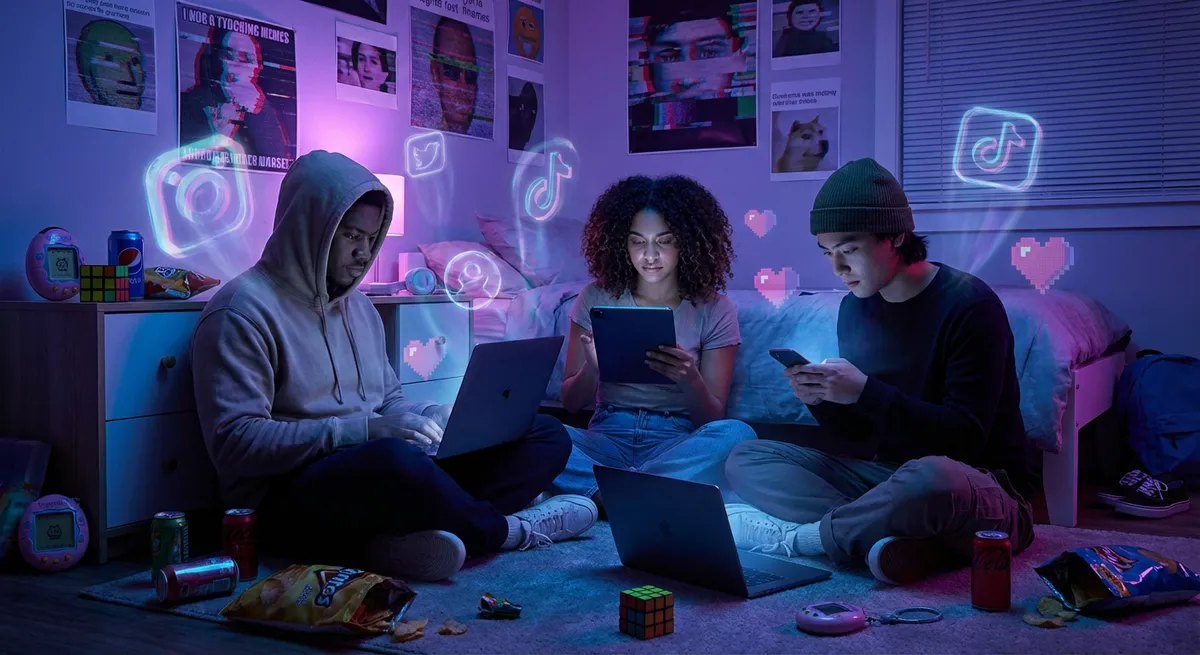
TikTok’s algorithm and other recommendation systems are speeding this up. You watch three videos about a topic, and your For You Page becomes a micro-universe. Suddenly you’re deep in “booktok,” “foodtok,” “gymtok,” “techtok,” or some cursed niche you can’t explain to non-internet people without sounding unwell.
The result: online identity isn’t just “I’m on social media.” It’s “I belong to this corner of it.” Follows, likes, and shares are becoming fandom signals—little badges that say, I’m from that side of the feed.
If your content speaks fluently to one of these micro-worlds, it doesn’t just perform—it belongs somewhere. That’s the new viral cheat code.
5. Screenshots Are the New Status Symbols
Forget the perfectly edited post—what’s really flexing online right now? Screenshots.
Receipts and screen grabs are becoming their own genre:
- Screenshot photo dumps: texts, tweets, notes app entries, playlists, DMs (with identities blurred… hopefully)
- People posting chat snippets as storytime previews: “Full story in the next slide”
- Screenshots of follower milestones, Spotify stats, Duolingo streaks, sleep trackers—your apps are now part of your personality
- Notes app confessions, mini essays, and soft-launch announcements
It feels casual but intentional: “I didn’t stage this, I just screenshotted my life.” That mix of raw and curated is catnip for platforms that reward authenticity but still thrive on drama and aesthetics.
On top of that, screenshots are ultra-shareable. They travel between apps—what started as a text becomes a story, then a tweet, then a meme. One moment, one grab, infinite timelines.
In a world where everything can look fake, screenshots are the new “you had to be there”—and apparently, everyone wants to be there.
Conclusion
The internet isn’t one single vibe anymore—it’s overlapping waves of aesthetics, micro-scenes, and experimental content styles all happening at once. Main-character posting, AI collabs, cozy chaos, fandom universes, and screenshot culture aren’t just random trends; they’re signals of where online life is heading: more personal, more fragmented, more creative, and weirder in the best way.
If you’re posting in 2025, you’re not just chasing views—you’re choosing a mode: cinematic, chaotic, collaborative, niche, or confessional. The magic happens when you mix them. So next time you open your camera app, remember: your feed is not just a timeline. It’s a tiny universe people can choose to live in. Make it somewhere they want to stay.
Sources
- Pew Research Center – Social Media Fact Sheet – Data on who’s using which platforms and how usage is evolving
- TikTok Newsroom – Product and Trend Updates – Official insights into new features and evolving content formats
- Instagram Creators – Official Tips and Trend Notes – Platform guidance on what types of content and behaviors are being amplified
- MIT Technology Review – How TikTok Reads Your Mind – Deep dive into how algorithmic feeds shape micro-communities and trends
- Harvard Business Review – The Dark Side of Social Media Trends – Context on the psychological impact and dynamics behind viral behaviors
Key Takeaway
The most important thing to remember from this article is that this information can change how you think about Internet Trends.